

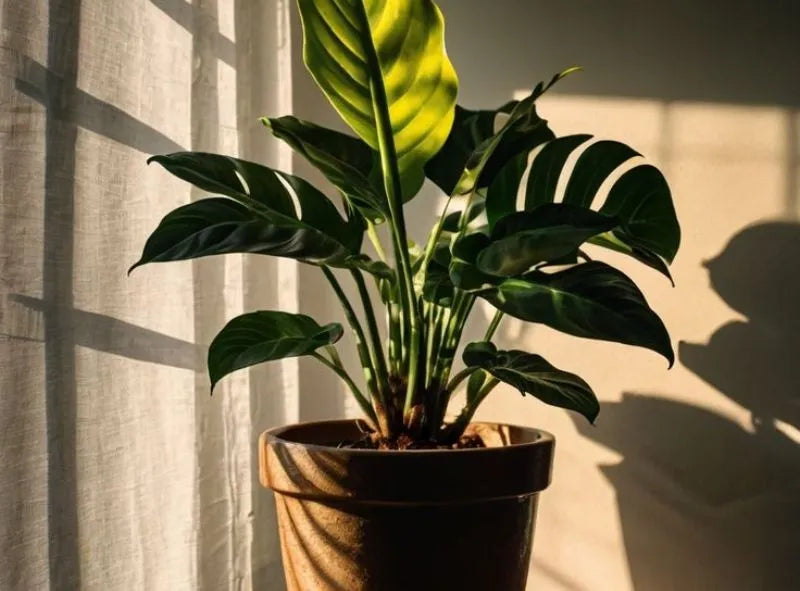
Houseplants often don't receive optimal lighting indoors, even when our interiors seem bright to us. It has to be said that they don't quite perceive light the same way we do — and yet it is particularly vital for them.
Why is light essential for houseplants?
The importance of photosynthesis
Most plants need a minimum amount of light so that the process of photosynthesis can take place, allowing them to live and grow.
This complex process converts light energy into chemical energy, producing the sugars necessary for their growth. Thanks to photosynthesis, the foliage displays its vibrant colour, and plants can develop in a healthy and vigorous way.
The signs of too little light
Houseplants are often lacking this essential element, as the light intensity can be too low (even though our eyes don't necessarily notice it).
A houseplant that doesn't get enough light will etiolate, meaning its stems will stretch more than normal in search of light, displaying an "abnormal" length, directed more or less clearly towards the room's light source.
If you've ever seen your plants leaning to one side, they're probably searching for light.
With a lack of light, they will grow less, or even stop growing altogether. Flowering plants will bloom less or not at all. New leaves become increasingly small, yellow or pale, and begin to fall.
The risk of root rot increases if watering doesn't match their needs, as it is under the action of light that the plant absorbs water. Pests are also often more numerous as the plant is weakened.
How to optimise light for your houseplants?
Moving the plant and regular rotation
To help your plants get more light, move them close to a light source. Regularly rotating the plant allows all sides to benefit from equal brightness — give it a quarter turn per week. This prevents the plant from growing asymmetrically and ensures uniform growth 🌱
Tips for maximising natural light
If you have curtains or even shutters, don't keep them closed during the day, especially in winter when light is particularly scarce.
Moreover, the dust that gradually settles on the leaves acts as a screen and reduces the efficiency of photosynthesis. Clean the foliage whenever necessary.
To clean your leaves, you can use the cleansing mist.
Formulated with natural ingredients and probiotics, this mist removes dust from the leaves by acting on the plant's microbiome for healthy growth.
Light-coloured walls and mirrors can help to reflect light around the room.
By placing your plants near reflective surfaces, you increase the light intensity they receive.
Some houseplants can sometimes also benefit from the installation of artificial lights.
Managing excess light
Recognising the signs of too much light
Conversely, some houseplants are overexposed to light, which is equally not beneficial for them. It needs to be neither too much nor too little.
The warning signs to watch out for are: leaves become misshapen, they curl or ripple, they turn pale, showing dry brown patches. Excessive light can burn the leaves and damage the plant in the long term.
Adjusting light exposure
After moving the plant away from the window, remove all the brown parts of the plant. You can also filter the light with a relatively thick sheer curtain or blinds. This allows you to modulate the light intensity and protect the plant from direct sunlight.
And above all, hydrate the plant well, without drowning it, to compensate for the stress caused by excess light.
To hydrate your plant perfectly, you can use an olla.
This porous ceramic water reservoir allows water to seep out slowly directly to the roots to hydrate them in an optimal and autonomous way. Plants take the water they need when they need it.
An olla will prevent you from over or under watering your plant.
Natural light or artificial light
Advantages of natural light
It's essential to place houseplants in a room with one or more windows.
That said, they don't appreciate being in direct sunlight, especially behind glass — the rays could scorch the leaves.
For good lighting, you can keep a filter (blind, sheer curtain…) on your windows on sunny days, or move the plants slightly further away (20 to 30 cm) if they face south or west.
Natural light is often sufficient for plants that don't have particularly high light requirements.
Using artificial light
Artificial light can be used to supplement natural light or as the sole light source — even if natural light is always better.
Not all artificial lights are equal for plants.
Plants have three types of photoreceptors :
- Phytochromes : sensitive to red light, they are essential for germination, chlorophyll formation, and flowering.
- Phototropins : sensitive to blue light, they adapt the "shape" of the plant to capture as much light as possible.
- Cryptochromes : sensitive to blue and ultraviolet light, they influence the growth of stems and leaves, as well as flowering.
Not all houseplants have the same light requirements, which are determined by their natural environment.
For example, cacti living in deserts need as much sun as possible, while ferns, living in forests, prefer light filtered through the trees.
Adapting lighting to each type of plant
Plants that love direct sunlight
Plants such as ficus, beaucarneas or phoenix palms, as well as succulents or carnivorous plants, love direct sunlight.
Plants that prefer indirect light
Plants such as the spathiphyllum, the cycas, and the schefflera prefer a west-facing exposure, very bright but without direct sun, or at the very end of the day when it is at its gentlest.
Plants tolerating partial shade
Green-leafed plants such as asparagus fern, anthurium, ivy, and aglaonema are generally less demanding in terms of light and can be placed in a north-facing position.
Those that enjoy gentle sun, such as the kentia, the philodendron or the alocasia, prefer a spot behind an east-facing window.
The light requirements of houseplants are shaped by their natural environment. It is crucial to arrange the lighting according to these specific needs to ensure their health and growth ☀️
Artificial lighting is an effective solution to compensate for a lack of natural light, meeting the needs of different varieties of houseplants.
By following these tips, you can create an optimal environment for your plants, helping them thrive fully in your home. 🌿


