

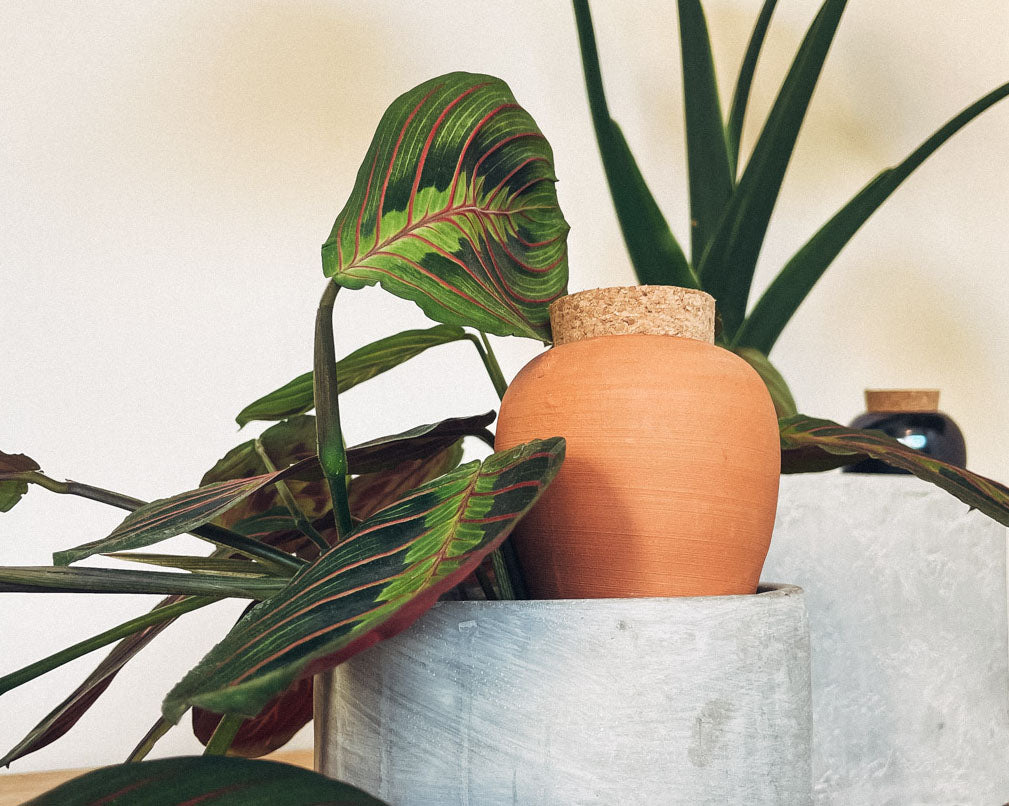
Natural, aesthetically pleasing and made from recyclable materials, they allow you to water plants gently, save water and above all go on holiday without any hassle! Loved by those who don't have green fingers as much as by fans of fussy plants, let's discover the benefits of this ecological and smart watering technique, which has become a must for contemporary, committed gardeners.
How to choose your oyas?
In shops, you'll find two types of oyas: those to bury and those to plant. What's the difference? And for what uses are they suited?
The oyas to plant
They generally have a smaller capacity (15 to 25 cl) and are glazed on the upper part. Designed mainly for houseplants, their shapes are made so as not to take up too much space in pots. They are therefore planted so that the water reservoir sits outside the pot.
They are very often glazed to make the part in contact with the air waterproof, but also to add a decorative touch to your plants and contribute to the atmosphere you want to create in your home.
For whom: The oyas to plant are ideal for houseplants. They are particularly used by city dwellers who don't have time to manage watering their plants, by plant addicts with very sensitive plants prone to overwatering, and of course by everyone who thinks they don't have green fingers but would love to create a little jungle at home.
Limits of the oyas to plant: Even though they are designed not to take up too much space, it can sometimes be necessary to repot your plants into larger pots for optimal use (a pot with a minimum diameter of 20 cm will be more comfortable). But this isn't necessarily a bad thing for your plants and their roots, which will have more space.
If you live in an area with very hard water, it may occasionally be necessary to descale your oyas with a brush and vinegar. The ideal is to go the extra eco mile by using rainwater to avoid any problems.
The oyas to bury
More commonly used in vegetable gardens, planters, or for very large houseplants, they have a more practical function, with capacities ranging from 70 cl to 6 l. They are buried in the soil, leaving only the top opening accessible for refilling. They are particularly effective throughout the growth cycle of annual plants, provided you choose them carefully. Indeed, it is more relevant to opt for elongated oyas, which will go deep enough into the soil.
In spring, it is best to wait until they are empty before refilling them. This encourages young shoots to develop deeper roots.
The aim is to make plants more self-sufficient during dry spells by drawing on the useful water reserves available deep in the soil. In summer, they are very useful for counteracting water loss due to soil evaporation. The plants' roots will have had time to develop around the oyas, and will be able to draw directly on the water they need day by day.
For whom: For everyone who wants to grow vegetables on their balcony or for gardeners used to summer droughts, but also for fans of ornamental borders who want to preserve their ecological footprint by saving on watering.
Downsides of the oyas to bury: If you live in a region with harsh winters, it is advisable to bring your oyas inside when temperatures drop below freezing. Their porosity makes them susceptible to frost. The oyas to bury are very effective with crops such as tomatoes, courgettes, beans or ornamental flowers, but less so with root vegetables such as carrots, turnips or onions. You are now well equipped to make informed choices about which oyas will suit you best.
Whether you're looking for a solution to water your houseplants during the holidays or you're starting a permaculture micro-garden, they'll easily find their place in your planting projects and will undeniably be a real helping hand in achieving satisfying results quickly and simply!


