

Your plants survived everything... except your holidays
We all know this scene. You come back tanned, rested, vaguely nostalgic for the sea. And there, in the hallway, the monstera greets you with its yellowed leaves and that accusatory look it's been perfecting for years. The guilt, for its part, never took a holiday.
Knowing how to water your plants while on holiday is genuinely one of the most asked questions as summer approaches. The neighbour? They forget. The DIY systems made from upturned bottles? They cause more damage than anything else. Result: every departure turns into an anxious negotiation with your plant conscience.
This is exactly where oya watering comes in. A terracotta object — discreet, beautiful, and devastatingly effective. No cables, no app, no neighbour to brief. But before explaining how it works, one small question: do you actually know what an oya is?
How a terracotta oya works (and why it's so clever)
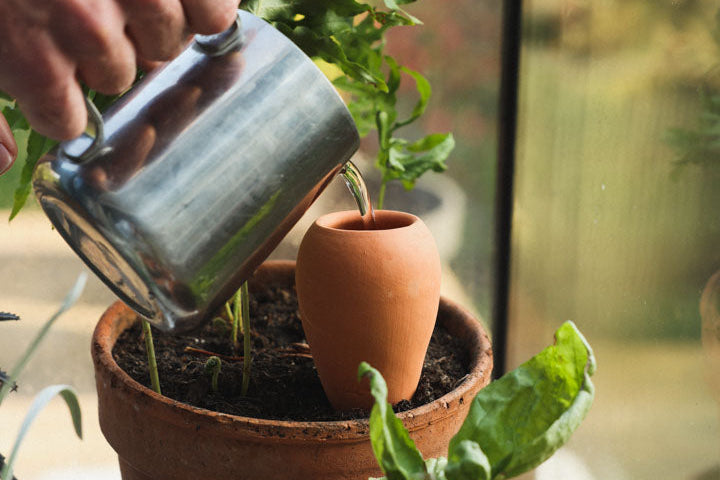
The principle is almost disconcertingly elegant. A terracotta oya is a small porous vessel that you push directly into the soil of your plant. Fill it with water, plant it, and it does the rest.
In practice, water slowly seeps through the microporous walls of the ceramic. The plant, via its nearby roots, draws exactly what it needs, when it needs it. If it's thirsty, it pulls. If it's had enough, it stops. This isn't magic — it's gentle physics working in the service of your pothos.
This oya watering system has existed for over 4,000 years. Traces of it can be found in China, Iran, North Africa and the Middle East. Entire civilisations fed their crops using this technique. What's changed today? The refined finishes that turn them into genuine decorative objects.
The cherry on top: by delivering water directly to the root, the oya reduces water consumption by 50 to 70% compared to conventional watering. And above all, it prevents overwatering — the number one cause of death for houseplants. There you have it. Well, almost.
Oya, DIY bottle or glass bulb: the honest comparison
DIY oya watering is generating a lot of buzz right now, and creative alternatives are everywhere on gardening blogs. Upturned plastic bottles, glass bulbs, capillary mats... All solutions that deserve a fair hearing. So here's an honest, no-nonsense comparison.
| Solution | Autonomy | Aesthetics | Ease | Effectiveness |
|---|---|---|---|---|
| Terracotta oya | Up to 10–15 days | Decorative object | Very simple | Excellent |
| Upturned plastic bottle | A few days | None | Simple | Hit and miss |
| Glass bulb | Around 1 week | Decent | Simple | Average |
| Capillary mat | Around 1 week | None | Complex | Good |
The verdict is pretty clear. The oya is the only solution that combines comfortable autonomy, a confident aesthetic, and effectiveness proven by centuries of use. Discover our terracotta oyas and choose the one that suits your plants — it's honestly the smartest investment of the summer.
Which oya size to choose based on your pot (the quick guide)
Good news: the choice is much simpler than it looks. At Pepin, we've deliberately kept the range super easy to read with two sizes, chosen based on pot diameter:
- "Pots under 15 cm in diameter — Mini Oya. Ideal for succulents, cacti, herbs, small pothos, peperomia, and all your little windowsill plants. It comes in a trio, in 4 colourways: Les Iconiques, Les Lovers, The Leopards and The Striped."
- Pots over 15 cm in diameter — Classic Oya. Our hero product, perfect for your adult pothos, monstera, ficus, philodendron or a balcony pot. Available in a wide variety of colourways and patterns (grainy white, sage green, mustard yellow, terracotta, heart, leopard, zebra, striped…).
For thirsty plants like calatheas or ferns, remember to refill the oya more frequently. And if you're looking for a beautiful gift for someone who loves their plants as much as you do, the Trio Mini Oyas Les Lovers has exactly the right look.
The holiday departure protocol in 5 timed steps
Here's the checklist to keep handy. Five steps, no more, to leave with a clear head thanks to a well-installed oya watering system.
- Check the moisture level of your compost. It should be slightly damp before installing the oya. Not bone dry, not waterlogged. Balance, always.
- Push the oya in up to the neck, close to the plant's roots without touching them directly. Not too close, not too far.
- Fill with room-temperature water, ideally low in limescale or filtered, then place the included stopper to limit evaporation.
- Move your plants away from sunny windows. Less direct heat, less thirst, more autonomy. Unbeatable logic.
- For absences of more than 15 days, ask someone to top it up. One visit is enough — it's hardly a burden anymore.
Knowing how to water your plants while on holiday is actually simpler than you'd think. And there you have it. Your plants are in good hands (terracotta ones).
What the oya won't do for you (the honest section)
We like you enough to be straight with you. The terracotta oya is brilliant, but it's not a therapist.
It's not ideal for absences exceeding three weeks without any top-up. In a very free-draining compost (like an ultra-light cactus mix), water sometimes diffuses too quickly and autonomy suffers. Worth bearing in mind if you have cacti in almost sandy soil.
Another important point: if your compost is completely dry when you install the oya, re-moisten it first. Otherwise, diffusion struggles to get going properly.
And finally: this oya watering system won't save a plant that's already on its last legs before you leave. If your leaves have been dropping for three weeks, sort that out first. The oya takes over when everything's going well — it doesn't perform miracles. Total honesty, we did warn you.
Frequently asked questions about watering with an oya
Are oyas really effective?
Yes, very. The on-demand diffusion principle allows the plant to draw water exactly when it's thirsty, reducing water consumption by 50 to 70% compared to conventional watering. Millennia of agricultural use confirm it.
What are the downsides of oyas?
The main limitations: they don't cover very long absences (more than 3 weeks), they're less suited to very free-draining composts, and they cost more than a DIY bottle. But the effectiveness and aesthetics more than make up for it.
Can you use an oya on a balcony or terrace?
Yes, absolutely. This article focuses on indoors, but the principle is exactly the same in a balcony pot or terrace planter. You bury the oya two-thirds deep in the compost, fill through the neck, and close with the stopper to limit evaporation. Great for spacing out watering during hot spells.
How do you water hoyas with an oya?
Watch out for a common mix-up: the hoya is a climbing plant with waxy flowers, the oya is the watering system. To water your hoya, a mini oya is ideal as this plant hates overwatering. The trio of mini oyas is perfect for that.


