

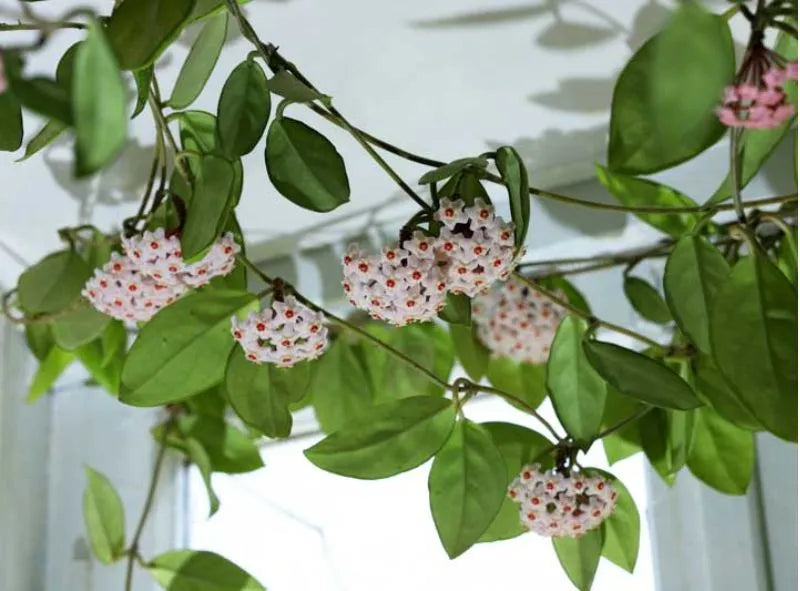
- ☀️Light
Thrives in bright, indirect light. Can benefit from a few hours of direct sun depending on the species.
- 💧Watering
Water every 1 to 2 weeks, allowing the soil to dry out between waterings. In winter, reduce the frequency of watering.
- 🤒Signs of an unhappy plant
Leaf spots on the leaves: too much sun exposure
Yellowing of leaves: overwatering
- ❤️🩹Ease of keeping alive
❤️🩹❤️🩹❤️🩹❤️🩹/5
🪴Today, we're talking about Hoyas! (not our products ;))
These houseplants have become incredibly popular, and for good reason. With their succulent leaves and delicate flowers, Hoyas bring a little something extra to any interior.
Discover how to grow and propagate them successfully.
Hoyas, also known as wax plants, are relatively easy to grow and propagate, and they produce beautiful, fragrant flowers.
Here's everything you need to know to care for your Hoyas.
Popular varieties of Hoyas
When you visit a garden centre or plant shop (probably right after reading this article), you'll usually find three to five different Hoya species.
However, there is a great diversity within this plant.
For example, Hoya carnosa is one of the most commonly grown species, and there are many varieties of this plant.
Hoya carnosa compacta, for example, has thick, succulent leaves that twist and curl in complex ways, adding an interesting texture to your plant collection.
Hoya carnosa crimson, on the other hand, stands out with its slightly red stems and variegated leaves, creating an attractive visual contrast.
The number of Hoya species varies depending on the source. We often hear of 300 to 400 species, but discussions with collectors and botanists suggest there could be between 600 and 700.... To be continued...
This uncertainty is due to a lack of documentation and different collection methods around the world. Some species may look identical but turn out to be different once they flower.
Habitat and growing conditions
Hoyas come mainly from subtropical and tropical regions, particularly Australia. They grow between sea level and one thousand metres in altitude, in environments where humidity and temperature are relatively stable.
Some high-altitude species are more difficult to grow at home due to their specific temperature and humidity requirements.
Species such as Hoyas carnosa, Hoyas multiflora, Hoyas bella and Hoyas pubicalyx are easier to grow indoors as they thrive in conditions similar to those you can create at home, with moderate humidity and a stable room temperature. These are therefore the ones we recommend to brighten up your living room with a Hoya.
Light and placement
At first, it's easy to think that Hoyas prefer intense direct light because of the succulence of their leaves. However, most Hoyas naturally grow under the canopy of trees and prefer bright, indirect light.
It is therefore best to place them in a spot with indirect light, such as an east-facing window, rather than directly south-facing.
Too much light can burn their delicate leaves, while insufficient light can slow their growth and reduce their flowering.
Growth structure of Hoyas
Hoyas have different growth structures.
For example, Hoya carnosa tends to wind around supports like a trellis, making it an excellent climbing plant for vertical spaces.
Others, like Hoya multiflora, have a bushier, more upright growth, making them ideal for growing in pots on shelves or windowsills.
Hoya bella, with its fine stems and small leaves, is perfect for hanging baskets where its stems can cascade down gracefully.
Finally, species like Hoya cumingiana grow upright before leaning over, creating quite an interesting visual effect.
The ideal soil mix
Hoyas are epiphytic plants, meaning they grow on other plants and need a well-draining soil mix. A good mix includes one third cactus mix, one third perlite for aeration, and one third orchid mix.
This type of soil allows Hoyas to dry out quickly between waterings, which is essential for their health. The perlite and orchid mix add aeration, preventing the soil from becoming compacted and ensuring the roots receive enough oxygen.
Propagation of Hoyas
The most common propagation method is cuttings. The stems can be rooted in water or sphagnum moss. Thick, fleshy stems often root more quickly in water, while those rooted in sphagnum adapt better to the soil substrate.
To propagate your Hoyas, you can cut a stem and place it in water or sphagnum. The nodes on the stem will begin to produce roots, and once well rooted, the cutting can be transplanted into a suitable potting mix.
When using sphagnum, make sure it stays slightly moist but not waterlogged. This allows the roots to develop without rotting.
Propagation in water is also effective — you'll see roots forming along the nodes after a few weeks.
Once the roots are well developed, transplant the cutting into a pot with the recommended potting mix.
Fertilisation and care
Hoyas are fertilised mainly during the growing season, which corresponds to spring, summer and autumn.
You can use our nourishing orchid serum, which is specially designed for epiphytic plants.
When Hoyas start to bud, this serum can be used to stimulate flowering.
Add a few drops of our serum to the watering water, once every 2 waterings, during its growth period. This will promote better rooting as well as better flowering.
Post-propagation care
After propagating your Hoyas, place the cuttings in a small pot with your potting mix. Hoyas prefer small, snug pots, as their roots love to grow in confined spaces.
Repot your Hoyas every two to three years to refresh the soil without necessarily increasing the pot size.
When repotting, inspect the roots to check their health and remove any rotten or damaged parts. Good drainage is essential, so make sure the pot has adequate drainage holes.
Place the pots in a bright spot but without intense direct light to help the cuttings thrive.


