

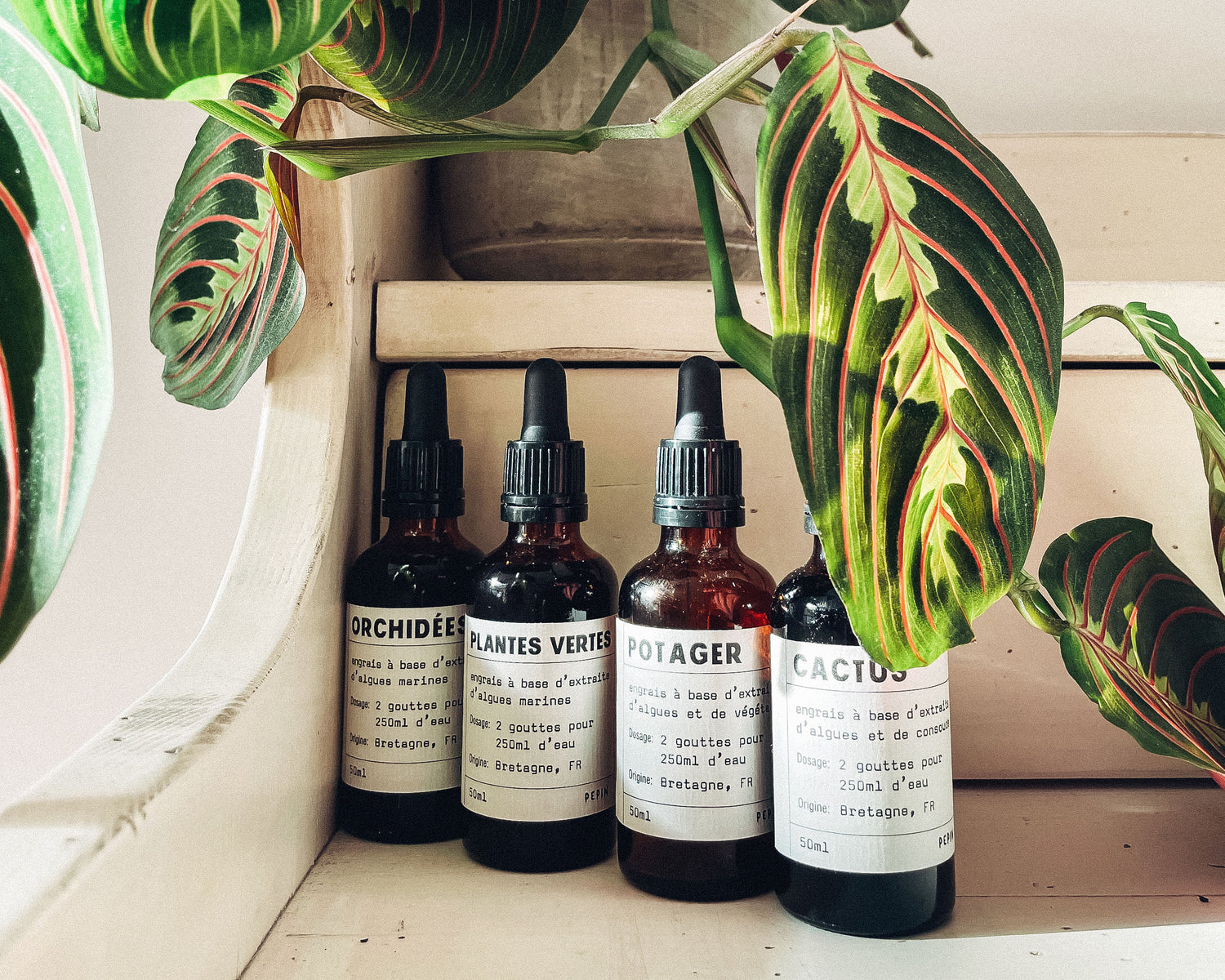
Owning houseplants can be a confusing activity! It's not always straightforward to anticipate their needs or to react correctly when you notice they're struggling. Is it a watering issue? A fertiliser issue? A pest attack? Poor light exposure? The reasons can be many, and it's impossible to cover everything in a single article. Let's focus today on the subject of fertilisers.
NPK fertilisers
Most houseplant fertilisers contain a mixture of macro and micronutrients. The three main macronutrients are nitrogen (N), phosphorus (P) and potassium (K). They are indicated as a ratio on the bottle. This NPK ratio tells you the quantity of each of these nutrients in the container (to be precise, by volumetric weight). The ratio of these macronutrients in a fertiliser for green plants or succulents differs, because each of these plant groups has different nutritional needs.
This means that using a fertiliser formulated specifically for the type of plant you have is essential. It's the first thing you should look for when buying a houseplant fertiliser. But be careful — it's unfortunately very common for fertiliser ranges to be marketed as specific, when they all share the same NPK ratio.
How to understand the NPK ratio? To simplify: nitrogen supports leaf production and photosynthesis. It helps produce leaves with a brilliant green colour and healthy foliage growth. Phosphorus contributes to bud formation and the plant's resilience. As for potassium, it supports flowering and fruiting (for vegetable or fruit plants), and also improves resistance against disease.
Many fertilisers, but not all, also contain secondary macronutrients such as calcium and magnesium, as well as micronutrients such as iron, zinc and boron. These nutrients are used in smaller quantities than the primary macronutrients (N, P and K), but they are nonetheless essential to the metabolism of every plant. You should make sure that your houseplant fertiliser also contains a small amount of these nutrients, sometimes called trace elements.
Should you choose a natural or synthetic fertiliser?
The ideal fertiliser is an organic fertiliser for houseplants. The macro- and micronutrients are obtained naturally and not from chemicals synthesised in a laboratory. Organic fertilisers are made from plant, animal or mineral components. Symbolically, think of a plant as working like a human body. Using a synthetic fertiliser is the equivalent of a vitamin drip. Using an organic fertiliser, on the other hand, creates a symbiosis between the plant and the life within its compost or soil. A bit like taking care of your gut microbiome to absorb the nutrients from what you eat in a more natural and effective way.
The different types of fertiliser for houseplants
Now that you know when to fertilise your houseplants and what nutrients houseplant fertilisers should contain, it's time to look more closely at the different types of houseplant fertilisers to determine which one suits you best.
Liquid fertilisers: they need to be used slightly more frequently than granular fertilisers, but organic liquid houseplant fertilisers are our favourites. They have the advantage of being more precisely dosed, and above all, they can be diluted in watering water. Their distribution to the roots is therefore more even. Liquid fertilisers also present a reduced risk of burning plants. Another advantage of using liquid fertilisers made from natural ingredients is that, in addition to providing nutrients, they also act as growth stimulators. They generally contain more micronutrients, trace elements, vitamins and amino acids than other fertilisers. This plays an essential role in the health and vigour of your houseplants. Organic liquid houseplant fertilisers are mainly made from seaweed, fish emulsion, compost tea, worm tea, liquid bone meal, natural phosphate, plant extracts and humic acids.
Granular fertilisers: they come in two forms: loose granules or compressed cones. Granular fertilisers are sprinkled on the surface of the soil. The cones are pushed into the soil to make better contact with the plant roots. As with liquid fertilisers, granular fertilisers for green plants can be made from naturally sourced ingredients. Most often, these will be dehydrated worm castings, bone powder, blood meal, potassium sulphate, limestone, natural phosphate or other ingredients of animal, mineral and plant origin. There are also synthetic granular fertilisers made from chemicals, but we don't recommend them for the reasons already mentioned. A quick check of the ingredient list on the label will tell you what the fertiliser is made from. If you see no ingredient list, it is very likely a synthetic fertiliser.
Slow-release fertilisers: also known as controlled-release fertilisers, slow-release fertilisers for houseplants are generally chemically manufactured. The liquid nutrients are encapsulated in a kind of capsule. This coating breaks down slowly and releases nutrients at a low dose over a long period. They have the advantage of requiring less frequent fertilising. That is admittedly convenient, but not very eco-friendly.
As you may have noticed, fertilising houseplants can ultimately be quite a straightforward practice. If you use the right products and apply them according to a seasonal schedule, your houseplants will be radiant and develop healthily for your greatest pleasure.


